
Bird of the Month: Common Red Poll
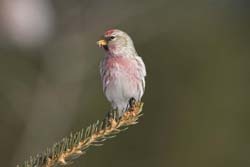
The Common Redpoll is a small brown and white songbird with heavily streaked sides. It has a small red forehead patch, black feathering around a yellow bill and two white wing bars. Males have a pale red vest on the chest and upper flanks.
Common Redpolls are birds of the arctic tundra and boreal forest. They migrate erratically occasionally showing up in the United States as witnessed by some lucky Washingtonians this winter. They travel in busy flocks foraging frenetically through weedy fields or small trees then swirl away in a chattering mass. During these irruptive years they will also congregate at feeders particularly ones filled with nyjer thistle or millet.
In the wild, Common Redpolls eat small seeds of birch, willow, alder, spruce and pine. They also eat grass and sedge seed and the seeds of wildflowers and the occasional berry.
The nest is built by the female and is made of grass, twigs, roots and tree moss. She lines it with a thick layer of ptarmigan or Spruce Grouse feathers, or with hair, lemming fur, wool or downy plant material.
The female will lay two to seven eggs that are pale green to pale blue with purple spots. The eggs will be incubated for eleven days and the chicks will fledge in nine to sixteen days.
Common Redpolls can survive temperatures of minus 65 degrees Fahrenheit. A study found that they put on 31% more plumage by weight in November than they do in July.
During winter, they tunnel into the snow to roost and stay warm. The insulating tunnels can be more than a foot long and four inches deep under the snow.
The next time you have access to a globe, look at it from the top. Common Redpolls breed around the world in the lands that ring the Arctic Ocean. Worldwide their numbers are estimated in the tens of millions.
Common Redpolls are intelligent birds that have no problem figuring out how to pull in a string to get a hanging piece of food. They often are seen shaking seeds out of birch catkins then dropping to the ground to pick them up.
These birds have a throat pouch that can store up to .07 ounces of seeds. They eat up to 42% of their body weight every day.
Common Redpolls are incredibly wide ranging. A bird banded in Michigan was recovered in Siberia, others from Alaska have been found in the United States and one bird that was banded in Belgium was found two years later in China.
The oldest known Common Redpoll was 7 years, 10 months old.